

A professionally speccedgarden room used as a home office typically costs between £200 and £500 a year to run. A poorly insulated one can cost significantly more, and insulation quality is the biggest single factor in that difference.
Most people research the build price thoroughly and give much less thought to what comes after. How the room is heated, what equipment runs inside it, and whether solar generation offsets any of the draw all shape the ongoing picture.
For anyone comparing a garden room against a loft conversion or extension, those garden room running costs are worth understanding before you decide.
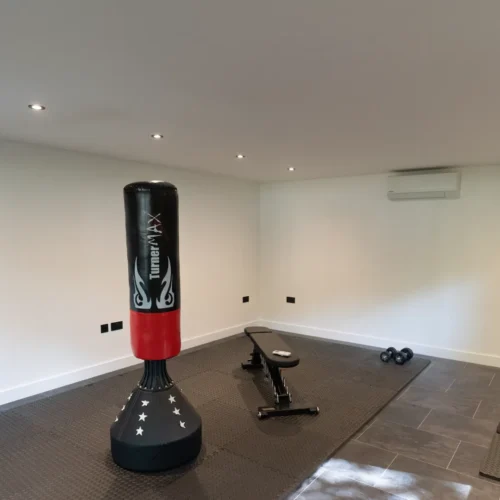
What Uses Electricity in a Garden Room?
Understanding the cost of running a garden office starts with knowing where the electricity goes, and it helps to think about this in two ways: always-on loads and occasional loads.
Always-on loads are the background draws that tick away whenever the room is in use, with LED lighting, Wi-Fi routers, and phone or laptop chargers falling into this group. Individually they’re modest, but they add up over a working week.
Occasional loads are where the bills can really move. These include:
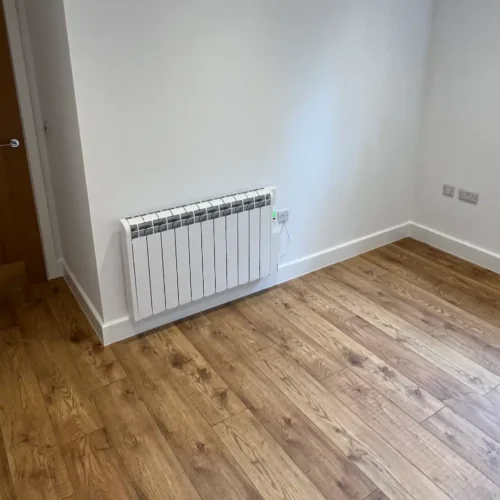
- Heating: An electric panel heater, infrared panel, or air-to-air heat pump will dominate your consumption during the colder months. This is the single biggest variable in your garden room electricity costs.
- Cooling or Dehumidification: Less common, but relevant in summer or in rooms used as art studios, music rooms or gyms.
- Equipment: A monitor array, studio lighting rig, gym equipment, or home cinema setup can materially increase your total draw depending on how often and how long the room is used.
The mix of loads in your garden room will depend on how you use it. An office with a laptop and a small heater looks very different from a fully equipped home gym running year-round.
How Much Does It Cost to Heat a Garden Room?
On the subject of heating, just how much does it cost to heat a garden room? Heating is where most of the money goes, so it’s worth getting a clear-eyed answer to this question before you commit to anything.
The starting point is the electricity unit rate. According to Ofgem, the average rate for Direct Debit customers under the price cap from April to June 2026 is 24.67p per kWh [1]. Using that figure, a 1.5kW panel heater running at full output costs roughly 37p per hour. A 600W infrared panel at full output costs around 15p per hour. Neither of those figures accounts for thermostat cycling, which means real-world costs are typically lower than continuous peak-output estimates suggest.
What garden room heating costs per month look like in practice depends on three things: how cold it gets, how long the room is occupied, and how well the building retains heat. A compact, well-insulated office used for a standard working week will cost considerably less to heat than a larger, poorly insulated room used across evenings and weekends too. The heater type matters, but insulation quality matters more. We’ll come to that in the next section.
How Insulation Affects Your Energy Bills
Insulation is the most direct lever you have over your garden room energy bills, because it controls how quickly heat escapes. A well-insulated room holds warmth for longer, so the heater runs for shorter periods and cycles less frequently. A poorly insulated room loses heat almost as fast as it’s generated, meaning the heater works harder and runs longer to achieve the same temperature.
The practical implication is that a well-insulated garden room can often be kept comfortable with a smaller heater and shorter runtimes. A poorly insulated one may need a larger heater that still struggles on cold days. Airtightness matters just as much as the insulation spec itself, because uncontrolled gaps and draughts undermine even a well-insulated building envelope, so a coherent approach to both is essential.
Garden room insulation savings are most visible over a full winter. The difference between a room built to a high insulation standard and one built to a minimum standard isn’t felt so much in mild weather. It shows up clearly from October through to March, when occupants of poorly insulated rooms are heating continuously and still finding the space uncomfortable.
Good Insulation vs Poor Insulation: The Annual Cost Difference
The most useful way to frame this comparison is through a practical scenario, because actual usage varies too much for a single fixed number to be meaningful. Garden room running costs split clearly between two profiles:
- Good Insulation: Lower heat demand, shorter heater runtime, and a modest annual heating bill for a space used as an office or hobby room. The heater does less work, cycling on briefly to maintain temperature rather than running continuously.
- Poor Insulation: Higher heat loss, longer heater runtime, and a substantially higher annual cost because the heater is constantly compensating for leakage through walls, roof, and floor.
To put some numbers around it: at 24.67p per kWh, every 100 hours of actual heater runtime at 1kW costs around £24.67. If better insulation halves the runtime needed to achieve the same comfort level, the heating portion of the bill falls by roughly half too. Over a full winter that difference compounds, and when you factor in garden room insulation savings across five or ten years of use, the case for investing in a well-built room becomes clear.
The cheapest garden room to run isn’t the one with the most efficient heater. It’s the one that needs the least heating in the first place.
Can Solar Panels Reduce Garden Room Running Costs?
Solar panels can make a meaningful dent in garden room running costs, particularly for spaces used during daylight hours. An office used from nine to five is well placed to consume solar generation directly, which means electricity that would otherwise be drawn from the grid at 24.67p per kWh is generated for free instead.
A single 400W panel can generate roughly 350 to 600kWh per year in the UK, depending on location, roof orientation, and shading. A 4kWp system can produce around 3,400 to 4,200kWh annually [2]. For a modestly used garden room, even a small installation can cover a significant share of annual demand. Surplus generation can be exported under the Smart Export Guarantee [3], though export rates are typically lower than the import rate, so self-consumption tends to offer the better return.
Garden room electricity costs that solar offsets most effectively are daytime draws, such as lighting, computers, monitors, and background heating loads. Conversely, large evening or weekend heating loads are harder to cover without battery storage. Ultimately, whether panels make financial sense depends on your roof, your usage pattern, and your current energy spend, but for many homeowners with a south-facing garden room or garage roof, the sums stack up well.
How To Keep Garden Room Running Costs Low Year-round
The biggest savings don’t come from buying better equipment. They come from building a better room. A well-constructed, highly insulated garden room with good glazing and a sensible orientation will cost less to run than a poorly built one regardless of what heating system you put inside it. That’s the starting point.
Beyond the building itself, a few habits and choices make a real difference to the cost of running a garden office across the year. Use a thermostat or timer so the heater only runs when the room is occupied. Choose a heater sized to the space rather than oversizing it. Seal draughts, keep doors and windows closed in cold weather, and use LED lighting throughout to keep the base load low.
If the room has suitable roof space and you use it during daylight hours, solar panels are worth investigating. The combination of good insulation and modest self-generation can bring garden room energy bills down to a level that compares very favourably with heating an equivalent space indoors.
The underlying principle is straightforward: the less energy a room needs, the less it costs to run. Investing in quality at the build stage pays back every month for the life of the building.
Get a Clear Picture of Your Costs Before You Build
If you’re trying to work out whether a garden room stacks up financially, it helps to talk through your plans with someone who knows the build process inside out. At Garden Room Solutions, we design and build highly insulated garden rooms from our base in Dorset, and we’re happy to give you honest, practical advice on what a room built to our standard will cost to run.
Get in touch via our contact form or call us on 01202 081198. We turn quotes around in 48 hours, and we can help you think through insulation, heating, and layout before you commit to anything.
References
[1] Ofgem, “According to Ofgem, the average rate for Direct Debit customers under the price cap from April to June 2026 is 24.67p per kWh”: https://www.ofgem.gov.uk/news/changes-energy-price-cap-between-1-april-and-30-june-2026
[2] Stratford Energy, “A single 400W panel can generate roughly 350 to 600kWh per year in the UK, depending on location, roof orientation, and shading. A 4kWp system can produce around 3,400 to 4,200kWh annually”: https://www.stratfordenergy.co.uk/how-many-kwh-does-a-solar-panel-generate-uk-output-explained/
[3] Ofgem, “Surplus generation can be exported under the Smart Export Guarantee”: https://www.ofgem.gov.uk/environmental-and-social-schemes/smart-export-guarantee-seg